
Bridge Loans in Michigan
Understanding A Bridge Loan In Michigan
Michigan’s commercial real estate market moves at a pace that conventional financing rarely matches. Whether you’re repositioning a multifamily building in Grand Rapids, stabilizing a retail strip center in Metro Lansing, or converting a former warehouse in Kalamazoo, the window between an opportunity and a closed deal can close in weeks , not months. A commercial bridge loan is built for exactly that gap.
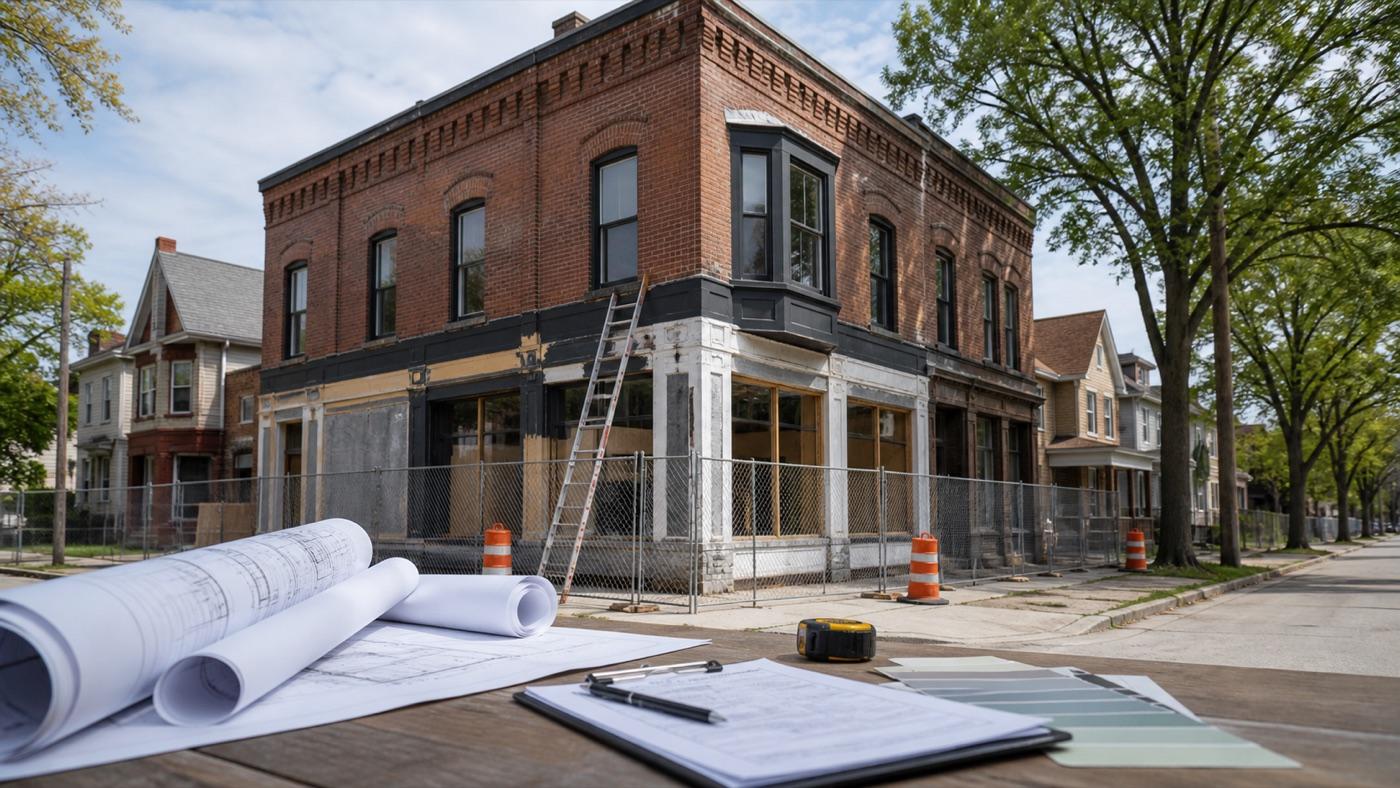
This page explains how commercial bridge financing works, what Michigan investors and developers should know before applying, and how AMZA Capital structures these loans for projects across the state.
What Makes A Bridge Loan Different From Conventional Financing
A bridge loan is a short-term, asset-secured loan used to cover the period between acquiring or refinancing a property and reaching a longer-term, stabilized financing solution. Conventional commercial mortgages require stabilized occupancy and extensive seasoning. Bridge loans are built for transitional properties , assets being repositioned, renovated, or filled out after a value-add strategy.
The structure is straightforward: interest-only payments keep monthly carry costs manageable while a project is under construction or in lease-up. Once the property is stabilized and income is reliable, the borrower refinances into permanent financing or sells the asset.
For Michigan investors, this structure fits the reality of value-add commercial real estate. A vacant mixed-use building in downtown Lansing, a partially occupied self-storage facility outside Ann Arbor, or a light industrial property in Flint that needs significant capital work , none of these would typically clear conventional underwriting standards on day one. A bridge loan lets investors move forward while the business plan is being executed.
How AMZA Capital Structures Commercial Bridge Loans In Michigan

AMZA Capital offers commercial bridge financing across Michigan (except Detroit) with a program built for purchase-and-rehab and refinance-and-rehab scenarios. Key program parameters:
Loan size: $500,000 and above
Loan-to-cost (LTC): 50% to 70%
Rate range: 9.49% to 14%, interest-only
Term: 12 to 36 months
Property types: Multifamily, retail, self-storage, office, warehouse, and some light industrial
Purpose: Purchase and rehab, or refinance and rehab
The interest-only structure means borrowers pay only on outstanding principal during the bridge period , a meaningful benefit on projects where cash flow is limited or nonexistent in the early stages. The 12-to-36-month term gives borrowers enough runway to execute a renovation plan without being forced to the exit before the business plan matures.
The LTC range of 50–70% is calculated against total project cost , acquisition plus budgeted renovation , not just the as-is appraised value. That distinction matters on value-add deals where the as-is value may be well below total cost.
What Property Types Work Best For Commercial Bridge Financing
Michigan has a diverse commercial real estate stock spanning multiple asset classes, and AMZA Capital’s bridge program covers a broad range of them.
Multifamily remains one of the most active categories for bridge financing in Michigan. Value-add apartment repositioning , upgrading units, improving common areas, pushing rents toward market , is a well-tested strategy in Detroit, Grand Rapids, and Lansing. A 20- to 40-unit building undergoing renovation often can’t carry stabilized debt until the work is done and units are occupied, which is precisely where bridge financing fits.
Retail is more nuanced but still active. Strip centers anchored by service tenants , grocery, medical, personal services , continue to trade, and buyers often need bridge capital while they reposition the tenant mix or address deferred maintenance. Michigan’s suburban retail corridors, particularly in Oakland and Macomb counties, see regular activity.
Self-storage has been one of the stronger-performing commercial sectors nationally, and Michigan is no exception. Facilities that need expansion, renovation, or climate-control upgrades are natural bridge loan candidates.
Office and warehouse , two asset classes with very different demand profiles , both appear in AMZA Capital’s eligible property types. Light office repositioning for medical or professional tenants, and warehouse upgrades to meet modern logistics or last-mile distribution standards, are scenarios where bridge capital is regularly applied.
Light industrial is considered on a case-by-case basis, reflecting the site-specific nature of those assets.
Why Michigan’s Commercial Real Estate Market Creates Bridge Loan Demand

Michigan’s economy has evolved considerably since the auto industry restructuring of the late 2000s. Manufacturing remains a foundation, but the commercial real estate market has diversified. Urban cores like Detroit have attracted meaningful investment in multifamily and mixed-use development. Secondary markets like Grand Rapids, Kalamazoo, and Traverse City have seen population growth that feeds demand for retail, apartment, and light industrial space.
That evolution creates a natural environment for bridge financing. Properties that were undervalued, underutilized, or neglected during periods of economic uncertainty can be repositioned for a different tenant base or use case , but repositioning takes capital, time, and a lender who understands transitional assets.
According to data from the CFPB’s mortgage lending database, commercial real estate lending activity varies significantly by market conditions, which is one reason investors often seek specialized bridge lenders rather than relying on traditional bank financing for transitional deals.
Understanding Loan-To-Cost Vs. Loan-To-Value In Bridge Underwriting
One of the more important concepts for borrowers exploring bridge financing is the difference between loan-to-value (LTV) and loan-to-cost (LTC).
LTV is calculated against the current appraised value of the property , the metric most conventional lenders use.
LTC is calculated against the total cost of the project: what you’re paying for the property plus what you’re budgeting to renovate it. Bridge lenders use LTC because it reflects the full capital stack and the scope of the business plan more accurately than a point-in-time appraisal on an asset that is explicitly being changed.
When AMZA Capital underwrites a bridge loan at 50–70% LTC, the loan amount is sized relative to the entire project cost, not just the purchase price. On a deal where a borrower is paying $2 million for a building and budgeting $800,000 in renovations, total project cost is $2.8 million. A 60% LTC loan would be $1.68 million. The borrower brings the remaining equity and proceeds to execute the plan.
This structure gives borrowers an incentive to be realistic about renovation budgets , the loan is tied to total cost, so underestimating scope has direct consequences. It’s one of the most common mistakes in bridge loan underwriting, and one of the most consequential.
What Michigan Investors Should Know Before Applying
Commercial bridge loans are not commodities. Terms, structure, and execution speed vary significantly between lenders. A few concepts are worth understanding before you engage with any bridge lender.
Budget contingency matters. Renovation projects routinely run over initial estimates because of permitting delays, material costs, or conditions discovered after acquisition. A well-structured bridge loan gives borrowers enough runway , in both term and capital , to absorb reasonable overruns. Borrowers who arrive with tightly drawn budgets and no contingency are more exposed when things don’t go to plan.
Exit strategy is underwritten alongside entry. Bridge lenders think carefully about how and when a borrower exits the loan. The most common exits are a refinance into agency or CMBS debt once the property is stabilized, or an outright sale. A credible, documented exit path is a meaningful part of any bridge loan request.
Interest-only means no amortization. During the bridge period, the loan balance does not decrease. The entire principal is due at maturity. Borrowers need to plan for this carefully, including maintaining enough liquidity to fund operations, carry costs, and the capital events required to execute the exit.
Asset class and market matter. Bridge lenders are selective about property types and submarkets. A self-storage facility in a supply-constrained Michigan market carries a different risk profile than an office building in a submarket with significant vacancy. Understanding how a lender views your specific asset and location helps you present the deal more effectively.
For borrowers working through these questions, the AMZA Capital free quote page is a practical starting point for getting preliminary feedback on deal structure.
Why Work With AMZA Capital On A Michigan Bridge Deal
AMZA Capital is a direct commercial lender, not a broker. That distinction matters because direct lenders control their own credit decisions, which generally produces faster and more predictable execution than working through a broker who is shopping a deal to multiple third-party sources.
Bridge loans are not set-it-and-forget-it products. They require active communication about project progress, draw management on renovation funds, and coordination around the exit. For Michigan investors, working with a lender who understands both the mechanics of bridge financing and the realities of commercial repositioning is worth prioritizing.
For AMZA Capital’s commercial bridge program, rates range from 9.49% to 14% as of July 27, 2026, and are subject to change. Rates vary based on FICO, borrower experience, property cash flow, and location.
Related Guides
More guides from AMZA Capital:
- DSCR Loans In Michigan
- Bridge Loan Rates
- Bridge Loan Requirements
- Bridge Loan Documents
- Bridge Loans in Texas
- Bridge Loans in Ohio
- All investor loan guides by state and program
START WITH AMZA CAPITAL’S FREE QUOTE PAGE.
This article is for informational purposes only and does not constitute financial or investment advice. AMZA Capital is a licensed mortgage lender (CA DFPI 60DBO 86104 | NMLS 2262631). Consult a licensed professional before making financial decisions.