
DSCR Loans in New York
Understanding A DSCR Loan In New York
New York’s real estate market rewards investors who can move decisively. Whether you’re adding a Brooklyn two-family to your portfolio, refinancing a Buffalo rental to pull out equity, or acquiring a small multifamily in Queens, the central question is almost never “can you personally afford the payment?” It’s “does the property generate enough rent to cover itself?” That’s exactly the logic behind a Debt Service Coverage Ratio (DSCR) loan,and it’s why this product has become a go-to financing structure for investors operating across the Empire State.
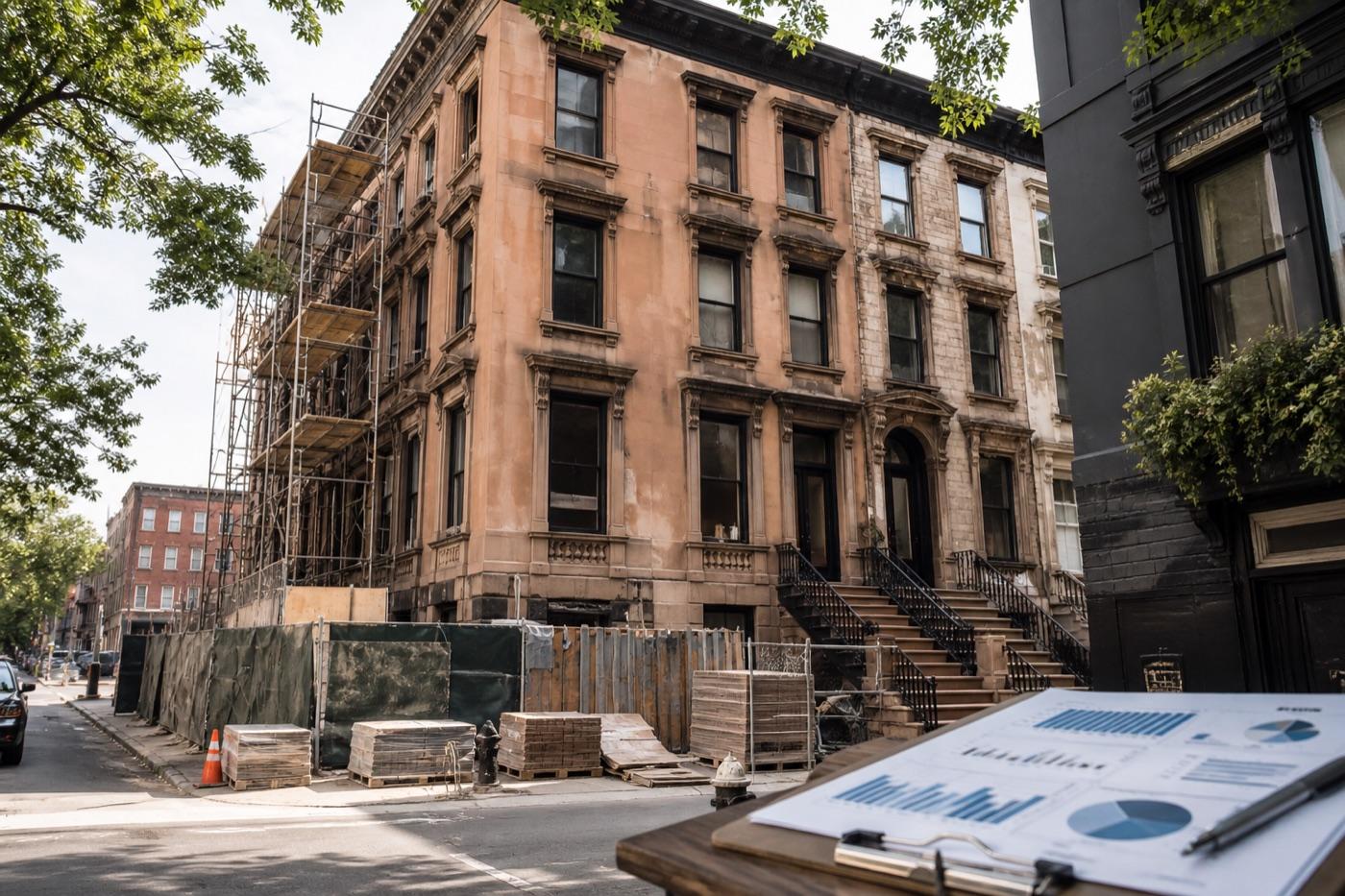
AMZA Capital structures DSCR loans specifically for buy-and-hold and cash-out refinance strategies on 1–8 unit residential properties. Here’s a practitioner-level breakdown of how these loans work, what New York investors need to know about underwriting them, and where the numbers actually matter.
What The Debt Service Coverage Ratio Actually Measures
DSCR is a simple ratio: gross monthly rental income divided by the total monthly debt obligation (principal, interest, taxes, insurance, and any applicable HOA dues). A DSCR of 1.0 means the property’s rent exactly covers its debt service. A DSCR above 1.0 means the property generates a surplus. Below 1.0 means it doesn’t fully cover the payment on its own.
What makes this useful for investors is that the lender’s primary underwriting lens shifts from the borrower’s W-2 or Schedule C income to the property’s revenue. An investor with multiple rental properties, significant depreciation write-offs, or self-employment income often looks weaker on a conventional mortgage application than their actual financial position warrants. DSCR lending sidesteps that problem by anchoring the credit decision to the asset.
For a concrete example: if a property in Astoria generates $3,800 per month in gross rent and the proposed loan payment (including taxes and insurance) comes to $3,200 per month, the DSCR is approximately 1.19. That’s a cash-flowing deal by most lender standards. If the rent were only $2,900 against the same debt service, the ratio falls below 1.0, and the deal requires more scrutiny or a different structure.
Why New York Specifically Presents Both Opportunity And Complexity

New York is not a monolithic market. Manhattan cap rates operate in an entirely different universe from Syracuse or the Hudson Valley. Upstate cities like Albany and Rochester have seen genuine rent growth as remote work shifted demand, while downstate markets remain among the most supply-constrained in the country. A DSCR lender with experience in the state understands that rent comparables, property taxes, and landlord-tenant law vary dramatically by county,and all of those factors flow directly into the DSCR calculation.
Property taxes deserve particular attention. New York’s property tax rates in certain counties are among the highest in the nation. Because lenders include the monthly tax escrow in the debt service figure, a property with an identical purchase price in Nassau County versus Onondaga County can produce meaningfully different DSCRs simply because of the tax line. Investors who run their numbers before approaching a lender,using actual county tax bills rather than estimates,present stronger files and avoid surprises at closing.
New York’s rent stabilization and rent control regulations also affect underwriting. Regulated rents cap what a borrower can show as market rent. If a building carries below-market stabilized rents, the DSCR calculation will reflect those actual rents, not what the unit might theoretically command. Investors should be prepared to document current leases or, for vacant units, provide market rent support through a third-party appraisal that includes a rent schedule.
The New York State Department of Financial Services regulates mortgage loan originator licensing in the state, and working with a properly licensed lender matters for compliance and borrower protection alike.
How AMZA Capital Underwrites DSCR Loans In New York
AMZA Capital’s DSCR program covers 1–8 unit residential properties, which makes it practical for the entire spectrum of investor activity,from a single-family rental in White Plains all the way up to a seven-unit building in the Bronx. Here are the core parameters you should know before initiating a conversation:
Minimum FICO score: 680. Credit quality matters even in asset-based lending because DSCR loans are securitized products and the borrower’s creditworthiness is still a factor in risk pricing. Research on securitization and underwriting risk, such as work published by the Federal Reserve, underscores how investor credit profiles interact with loan performance at a portfolio level.
Minimum property value or purchase price: $120,000. This keeps the program focused on properties that meet secondary market liquidity thresholds.
Maximum LTV on purchase: 80%. Bringing at least 20% equity on an acquisition is standard for DSCR lending and reflects the program’s focus on investors rather than owner-occupants.
LTV on cash-out refinance: 75–80%. The specific ceiling depends on property type, market, and credit profile. Investors pulling equity from a performing rental to fund a next acquisition should model both ends of that range when projecting their net proceeds.
Rate range: 6.00–8.99% on a 30-year fixed structure. Rates within that range vary based on DSCR, LTV, credit score, property type, and market conditions as of the time of application. A 30-year fixed term provides payment stability that supports accurate long-range cash flow modeling,particularly useful in New York, where operating costs like insurance and taxes tend to escalate over time.
Seasoning requirements: This is where many investors get tripped up, so pay close attention.
- If you purchased the property with cash and it has not been recently rehabbed, you need a minimum of six months of ownership before the lender will use an appraised value (rather than the purchase price) as the basis for a cash-out refinance.
- If the property is currently under a loan, the minimum seasoning before a rate-and-term or cash-out refinance is 90 days.
- If the property was rehabbed within the last 12 months, there is no seasoning wait,you can move directly to a DSCR refinance based on the as-is appraised value. This is a significant advantage for investors who buy, improve, and then want to stabilize with long-term financing.
That last point,no seasoning for recently rehabbed properties,is particularly relevant in New York markets where value-add plays are common. An investor who acquires a distressed two-family in Rochester, completes renovations, and places tenants can refinance immediately, recycling capital into the next deal without an arbitrary waiting period.
Building A File That Underwriters Can Work With

DSCR underwriting is asset-focused, but the documentation package still matters. Here’s what experienced New York investors typically prepare before submitting a loan application:
Rent documentation: Current executed leases for all occupied units. For vacant units, the appraiser will provide a market rent opinion as part of the appraisal process, but any internal projections you rely on should be grounded in realistic comparables for the specific submarket.
Entity structure: Many New York investors hold properties in LLCs. DSCR lenders generally accommodate entity borrowing, but the structure needs to be clearly documented, including the operating agreement and any required personal guarantees.
Insurance: New York properties, particularly in coastal or flood-prone areas, can carry above-average insurance premiums. Because insurance is included in the debt service calculation, elevated premiums compress DSCR. Investors should get binding insurance quotes before finalizing their loan request so the actual cost is reflected in projections.
Property tax verification: Pull the actual county tax records rather than using listing-provided figures, which are sometimes based on prior assessments. In New York, tax grievances and abatements can also affect the figure; if a property has a tax abatement with a scheduled expiration, underwriters will want to understand the post-abatement obligation.
Property condition: DSCR lenders require an appraisal, and most require that the property be in rentable condition. Properties with significant deferred maintenance may require repairs before closing or may not clear a standard DSCR appraisal.
When A DSCR Loan Makes Sense Versus Other Products
DSCR is not always the right structure. It’s most naturally suited to stabilized or near-stabilized rentals with documented or documentable income. If you’re acquiring a completely vacant building and need time to lease it up, a bridge or hard money loan may be the more appropriate first step, with a DSCR refinance as the planned exit once the property reaches stabilized occupancy.
For New York investors who operate stabilized portfolios and have been turned down or limited by conventional loan count restrictions (Fannie Mae limits investment property loans to ten per borrower), DSCR provides a genuine alternative. The loan is underwritten to the property rather than to an aggregate personal balance sheet, which makes it viable for investors who have already maxed out their conventional capacity.
For investors exploring other financing strategies, the full range of AMZA Capital programs is detailed at amzacapital.com.
Getting Started With A DSCR Quote In New York
The most efficient path forward is to run your target property’s numbers,current or projected rent, estimated taxes, insurance quote, and proposed loan amount,and then connect with a lender who can tell you where those numbers land against program parameters.
For AMZA Capital’s DSCR program, rates range from 6.00% to 8.99% as of July 27, 2026, and are subject to change. Rates vary based on FICO, borrower experience, property cash flow, and location.
Related Guides
More guides from AMZA Capital:
- DSCR Loan Down Payment Requirements
- DSCR Loan Credit Score
- DSCR Loan Prepayment Penalty
- DSCR Loans in Maryland
- DSCR Loans in Hawaii
- All investor loan guides by state and program
START WITH AMZA CAPITAL’S FREE QUOTE PAGE.
This article is for informational purposes only and does not constitute financial or investment advice. AMZA Capital is a licensed mortgage lender (CA DFPI 60DBO 86104 | NMLS 2262631). Consult a licensed professional before making financial decisions.