
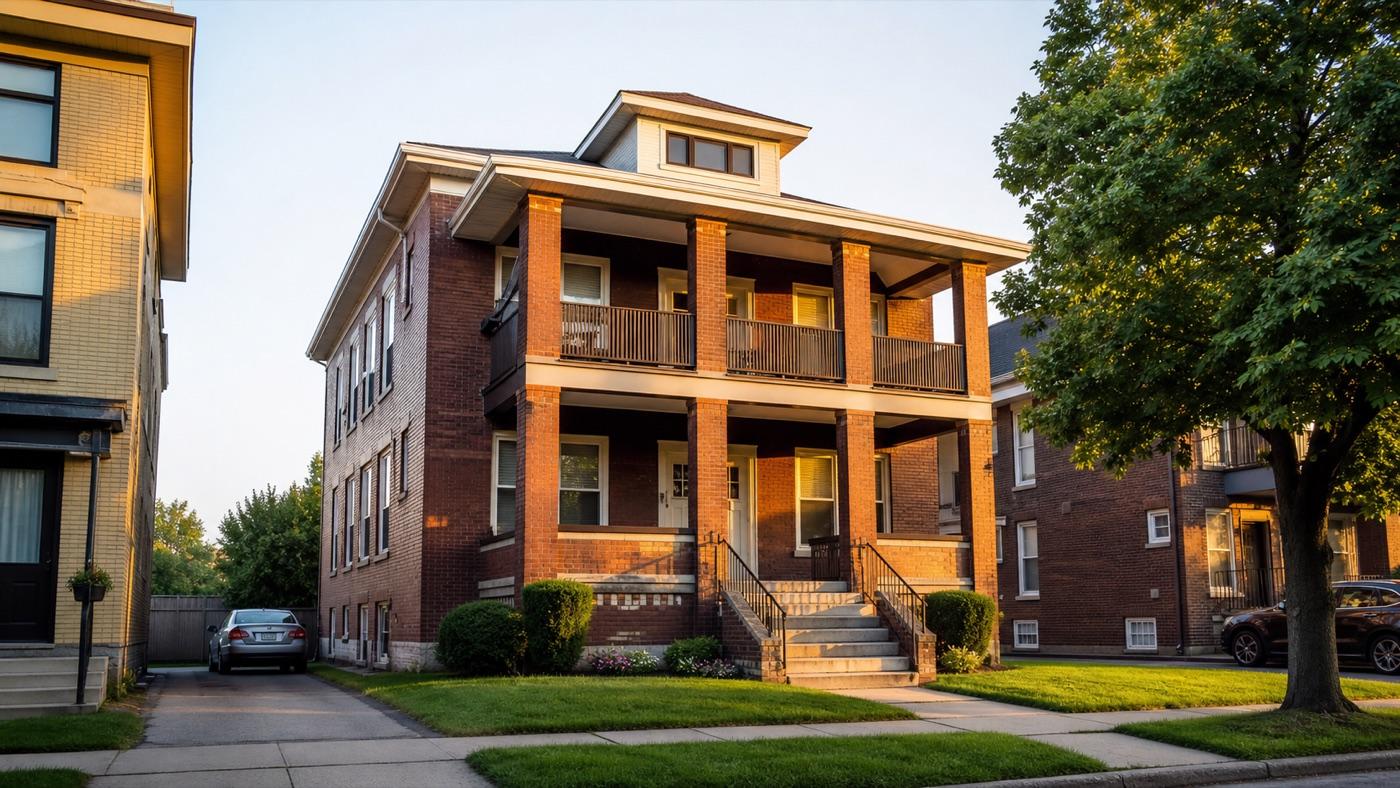
Say you own a four-unit in Cleveland’s Ohio City neighborhood. The rents are solid, you’ve held the property for three years, and you want to pull out equity to fund your next acquisition. You call a conventional lender and immediately hit a wall: your W-2 doesn’t reflect what the property is actually doing for you. Depreciation, write-offs, and pass-through deductions have made your tax returns look thin. The rental income is real. The paper income is not.
This is the problem DSCR lending was built to solve.
A debt service coverage ratio loan qualifies the property on its rental income, not on what you show on a 1040. For Ohio investors working stabilized rentals in Columbus, Cincinnati, Dayton, Akron, or any of the state’s secondary markets, that distinction can be the difference between growing a portfolio and waiting on a conventional loan that may never pencil.
What DSCR Actually Means In Cash-Flow Terms
DSCR stands for debt service coverage ratio. The calculation is straightforward: divide the property’s gross rental income by its total debt service, which typically means principal, interest, taxes, insurance, and any HOA dues, depending on how the lender structures the payment denominator.
A ratio of 1.25 means the property generates $1.25 in rent for every $1.00 in debt obligations. That cushion is what lenders are pricing when they set rates and leverage caps.
At 1.00, the property breaks even on paper. It’s covering the debt and nothing more. Most lenders will still work with a file at that level, but they’ll adjust terms to reflect the tighter margin. Below 1.00, you’re in what’s sometimes called a no-ratio or sub-1 DSCR situation. That doesn’t automatically close the door, but it usually means renegotiating the structure or looking at a different product.
Knowing where you fall before you call a lender is the most practical thing you can do. It tells you what to expect from pricing, what leverage is realistic, and whether DSCR is even the right instrument for your situation.
What Goes Into The Ratio: Leases, Rent Schedules, And Carrying Costs

The numerator in the DSCR formula is your rental income. Lenders verify that income through some combination of executed leases for all units, a current rent roll, and a market rent analysis from the appraisal.
That last item matters more than many borrowers expect. The appraiser will produce a Form 1007 rent schedule for single-family properties, or its multifamily equivalent, comparing your actual rents against comparable rentals in the market. If your actual rents run above market, the lender may underwrite to the market figure. If you’re below market, some lenders use actual rents, others credit market rents, depending on occupancy and lease terms.
For the denominator, the lender adds up the proposed mortgage payment plus property taxes and insurance. On condos or planned unit developments, HOA dues typically go in too. The resulting number is your PITIA: principal, interest, taxes, insurance, and association dues where applicable.
Here’s where investors sometimes miscalculate before they submit. They run DSCR off the mortgage payment alone, arrive at a comfortable ratio, and then watch it drop when taxes and insurance go in. Make sure you’re working with the full carrying cost. Insurance in particular has moved significantly in recent years and can affect ratios more than investors anticipate.
A Cleveland 4-Unit That Crossed The Finish Line
This file illustrates why DSCR underwriting looks at the property, not the borrower’s tax returns.
An Ohio investor came to AMZA Capital with a stabilized four-unit in Cleveland, looking to cash out equity for a down payment on another acquisition. The problem: conventional underwriting was using Schedule E income from the prior two years, and depreciation and interest deductions had effectively zeroed out the net rental income on paper. The property wasn’t losing money in any practical sense. The rents were current, the building was occupied, and operating history showed consistent income.
The DSCR file told a different story. Executed leases on all four units, an updated market rent analysis from the appraisal, and two years of clean operating history supported a ratio that cleared the threshold for the refinance. The borrower’s tax-return income was never the issue because DSCR underwriting never asked for it. What mattered was the income the property was generating and whether that income covered the proposed debt.
The cash-out refinance closed. The equity went into a new acquisition. That’s the scenario DSCR exists to handle.
DSCR Tiers And What They Mean For Your File
Most DSCR lenders, including AMZA Capital, think about ratio tiers roughly as follows.
1.25 and above is generally where you see the most favorable pricing and the highest available leverage. The property shows meaningful income above its debt obligations, and files in this range tend to move through underwriting without much friction.
1.00 to 1.24 is workable, but expect trade-offs. Lenders may reduce maximum LTV, apply a pricing adjustment, or ask for additional documentation on lease stability and operating history. If you’re in this band, a clean record of on-time rent collection can help your case.
Below 1.00 is where DSCR may not be the right fit. Some lenders offer no-ratio DSCR programs, but the pricing reflects the additional risk. For Ohio borrowers in this situation, a 12-month bank statement loan may be a more practical alternative, particularly for investors with strong business banking activity. That path is worth discussing if DSCR doesn’t land where you need it.
Terms depend on many variables: market conditions, property profile, borrower credit, requested leverage, and lender appetite at a given time. No one can quote you a firm rate before a file is fully underwritten. Be skeptical of anyone who does.
How To Prepare Before You Submit A File
Ohio investors who have seen a DSCR file go smoothly tend to show up organized. A few things that consistently make a difference:
Executed leases for every unit, current and signed. Month-to-month tenants aren’t disqualifying, but a term lease signals stability. If leases are expiring soon, get renewals in place before you submit.
Clean rent collection history gives underwriters something concrete to work with. Bank statements or a property management report showing consistent on-time payments over 12 or more months is useful supporting documentation.
Accurate insurance quotes for the subject property. If you’re working from an old policy, run a fresh quote. Insurance costs have increased across much of Ohio, and an outdated estimate will distort your ratio before you even get to the lender.
Current property tax figures from the county auditor’s office. Ohio’s county auditor portals are generally reliable for assessed value and tax data. The Ohio Division of Real Estate and Professional Licensing also maintains resources relevant to property professionals navigating state-level requirements.
For a more detailed look at what lenders are actually looking for when you submit a DSCR file, the AMZA Capital resource on what real estate investors should prepare for DSCR loans covers the documentation side in more depth.
How AMZA Capital Screens An Ohio DSCR Request
When an Ohio DSCR request comes in, the first question is whether the property fits eligible product parameters. DSCR lending at AMZA is available for one-to-four unit residential investment properties in Ohio, covering the full range of small rental configurations: single-family rentals, duplexes, triplexes, and four-unit buildings.
From there, the review focuses on the rent roll and appraisal, the proposed debt structure, and how the ratio lands under full PITIA. Credit and leverage factor into pricing. The central underwriting question stays simple: does the property’s income support the loan?
If DSCR doesn’t work cleanly for your current situation, there may be other paths. A bank statement review can create another option for investors whose income is real but doesn’t show up neatly on a tax return. You can explore options at AMZA Capital’s rental property financing page.
Starting Your Ohio DSCR Conversation
If you’re sitting on Ohio rental income that works in the real world but doesn’t fit conventional underwriting, a DSCR loan is worth a serious look. Run your numbers before you call. Know your actual rents, your full monthly carrying cost, and your approximate ratio. That preparation makes the first conversation faster and more useful for both sides.
Related Guides
More guides from AMZA Capital:
- Fix And Flip Loans In Ohio: What Investors Should Prepare Before Requesting Terms
- Private Money Lenders In Ohio: How Investors Should Prepare A Fundable Deal
- DSCR Refinance: What Rental Investors Should Confirm Before Replacing Bridge Debt
- Rehab To Rent Loans: How Investors Should Plan The Bridge To DSCR Exit
- Debt Service Coverage Ratio Loan: How Rental Property Cash Flow Shapes Underwriting
- DSCR Loans in Florida
- All investor loan guides by state and program
START WITH AMZA CAPITAL’S FREE QUOTE PAGE.
*This content is provided for informational purposes only and does not constitute financial, legal, or investment advice. AMZA Capital is a licensed mortgage lender (CA DFPI 60DBO 86104 | NMLS 2262631). Actual loan terms, rates, and availability vary. Consult a licensed financial professional before making investment decisions.*