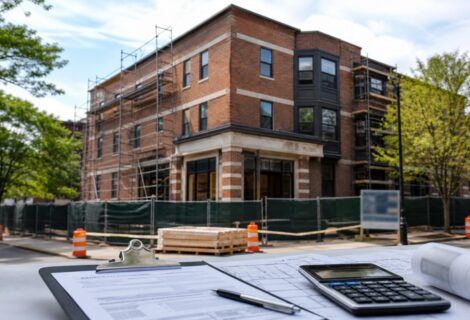

Bridge loans are built to move fast. They help investors close on distressed assets, fund renovations, and stabilize occupancy before permanent financing becomes available. But they were never designed to sit on a portfolio indefinitely. The interest reserves burn off, the balloon payment approaches, and at some point the clock forces a decision: refinance into long-term debt or sell. For rental investors who want to hold, a DSCR refinance is often the cleanest path forward,but only if the file is actually ready.
DSCR, or debt-service coverage ratio, is the underwriting metric that tells a lender whether a property’s rental income can support its proposed debt obligation. A DSCR of 1.0 means income exactly equals debt service. Most lenders target 1.20 or higher, though minimum thresholds vary by program and loan structure. What matters more than the headline number is whether every element that feeds into that ratio is documented, defensible, and correctly assembled before a borrower submits a file,because incomplete submissions stall deals, and stalled deals can create real problems when a bridge maturity is live.
This article walks through each layer of a DSCR refinance file so investors know exactly what to confirm before engaging a lender.
Why Bridge-To-DSCR Exits Require Extra Preparation
A bridge loan was underwritten on a forward-looking thesis: the property would be acquired, improved, and stabilized. The DSCR refinance is underwritten on what actually happened. Those two pictures are often different, and the gap between them is where deals get delayed or declined.
Common friction points include properties that appraised below the investor’s ARV projection, renovations that ran over budget and compressed equity, or rental rates that came in below the proforma. Each of those scenarios affects the maximum loan amount a DSCR program can support. Because DSCR lenders size the loan based on cash flow,not purchase price, not rehab cost,the refinance proceeds may not fully retire the bridge balance. Investors who haven’t modeled this gap carefully sometimes arrive at closing short.
Understanding the mechanics early prevents surprises. According to NAR research and statistics, rental demand and occupancy trends vary meaningfully by market and property type, which directly affects the rent comparables a lender will accept when sizing income. Knowing your local market data before you submit means you can anticipate how an appraiser or underwriter will view your rent roll.
The Property-Level Information Lenders Review First

Every DSCR file begins at the asset itself. Before a lender can quote terms or run a preliminary sizing, they need to understand what the property is, where it is, and what it produces.
Property Address And Classification. The address seems obvious, but classification matters. A single-family rental, a 2-4 unit multifamily, a 5+ unit apartment building, and a short-term rental are underwritten under different program guidelines. Confirming the correct asset type prevents misrouted applications.
Current Appraised Or Estimated Value. DSCR lenders use an as-is value,not ARV,because the property should already be stabilized at the time of refinance. Investors should know the current market value based on recent comparable sales, not the number that justified the original bridge loan. If an appraisal was conducted within the last six to twelve months, it may still be usable depending on market movement, but a lender will order a new appraisal before committing to final terms regardless.
Rehab Scope And Completion Status. If renovation work was done under the bridge, lenders want to understand what was completed. A certificate of occupancy, final inspection sign-off, or contractor completion documentation supports the transition from a construction-phase asset to a stabilized one. Incomplete work creates a problem: DSCR programs generally require the property to be fully functional and habitable.
Existing Debt On The Property. The bridge payoff amount,principal, accrued interest, any extension fees, and prepayment penalties,needs to be confirmed precisely. That figure, plus closing costs on the new loan, determines how much the DSCR refinance must produce to achieve a clean exit. Investors who confuse the outstanding principal with the actual payoff balance frequently find themselves short at the wire.
Rental Income: How Lenders Quantify The Cash Flow
Cash flow is the foundation of every DSCR calculation. Lenders are not simply taking your word for what the property earns,they are reviewing documentation and making their own assessment of sustainable income.
Signed Leases And Current Rent Rolls. For long-term tenants, a current, signed lease is the gold standard. It should show monthly rent, lease term, and tenant name. If a lease is month-to-month, most lenders will accept it but may apply a conservative vacancy factor. If the unit is vacant at the time of application, the lender will typically use a market rent estimate derived from the appraisal rather than any proforma projection the investor provides.
Market Rent Support. Even with an occupied property, lenders often test whether the contract rent is in line with comparable market rents. If a lease is at or below market, that’s generally not an issue. If contract rent significantly exceeds what the market data supports, underwriting may haircut the income figure,which reduces the DSCR and potentially the maximum loan amount.
Short-Term Rental Income. Properties operating as short-term rentals require different documentation. Lenders evaluating STR income typically look at trailing twelve-month gross revenue pulled from the platform, occupancy rates, and a net income figure after host fees and operating expenses. Some DSCR programs do not allow STR income treatment at all, so confirming program eligibility before applying is essential. AMZA Capital’s guide to DSCR loan preparation covers documentation requirements in detail for investors preparing their files.
Borrower-Level Factors That Affect Program Eligibility

DSCR loans are asset-based products, which means the property’s income drives the primary underwriting decision. But borrower-level factors still matter, and they can affect pricing, required reserves, or program availability.
FICO Score. Most DSCR programs have minimum credit score thresholds. Scores also affect the rate tier a borrower qualifies for,the difference between a 680 and a 740 can translate to meaningfully different pricing. Investors who know their score and have reviewed their credit report for errors before applying are in a better position to discuss where they’ll land on the pricing grid.
Liquidity And Reserves. Lenders want to see that borrowers have cash reserves sufficient to cover several months of PITI after closing. The exact reserve requirement varies by lender and loan amount, but the principle is consistent: a borrower who owns a rental property should be able to absorb a vacancy or a repair without defaulting on the loan. Confirming the source and documentation of reserves before applying,whether that’s a checking account, brokerage account, or retirement account,prevents late-stage surprises.
Entity Structure. Many rental investors hold properties in LLCs or other entities for liability protection. DSCR programs can accommodate entity borrowing, but lenders will want to see operating agreements, evidence of good standing, and sometimes personal guarantees from the principals. Having these documents current and organized avoids delays.
Investment Experience. Some DSCR programs price or underwrite differently based on whether the borrower is a first-time investor or an experienced operator with a seasoned portfolio. Being prepared to document prior investment history can support favorable terms.
Exit Plan And Loan Purpose Clarity
A DSCR refinance can serve different purposes depending on the investor’s strategy. It may be a straightforward rate-and-term refinance to retire the bridge and lock in long-term financing. It may be a cash-out refinance to pull equity and redeploy capital into the next acquisition. Or it may be a delayed purchase refinance,where an investor bought with cash and is now leveraging up to recapture equity.
Each of those scenarios has its own underwriting nuance, timing requirements, and seasoning rules. Rate-and-term refinances typically have simpler documentation requirements than cash-out transactions. Cash-out refinances may have LTV constraints that limit how much equity can be extracted. Delayed purchase refinances often require the investor to have owned the property for a specified seasoning period before proceeds are treated as a cash-out.
Knowing which scenario applies,and confirming that the file is positioned correctly for that loan purpose,prevents the file from being underwritten incorrectly, which wastes everyone’s time.
Building A Complete File Before You Submit
Submitting a complete, well-organized file is the single most effective thing an investor can do to accelerate the refinance process. Incomplete submissions don’t get faster turnarounds,they get queued for clarification, re-reviewed, and sometimes passed over entirely when a lender’s pipeline is full.
Before contacting AMZA Capital or any lender, investors should have in hand: a confirmed property address with current estimated value, a clear account of the rehab completed and any remaining work, the exact bridge payoff figure including all fees, current signed leases or documented market rent, FICO score and reserve documentation, entity paperwork if applicable, and clarity on whether the transaction is rate-and-term, cash-out, or a delayed purchase refinance.
With that information organized, lenders can give meaningful, specific feedback,not a range of hypothetical scenarios that may or may not apply to the actual deal.
AMZA Capital (CA DFPI 60DBO 86104, NMLS 2262631) works with rental investors across the country on DSCR refinances and other real estate financing solutions. Getting the right information to the right lender, in the right format, is what turns a bridge exit into a funded long-term hold.
START WITH AMZA CAPITAL’S FREE QUOTE PAGE.
*This article is provided for informational purposes only and does not constitute legal, financial, tax, or investment advice. Loan programs, eligibility requirements, rates, terms, and availability are subject to change without notice and vary based on individual circumstances, property characteristics, and market conditions. No commitment to lend is expressed or implied. Consult qualified legal, financial, and tax professionals before making any financing or investment decisions.*